Friday, July 20, 2007

Alternative Agriculture for Renewable Fuels

Vertical Farm Project
(image from www.verticalfarm.com)


It's true! It CAN be done!


I know I don't get more than a handful of readers, but for those of you who have read June 11th's post about bio-fuels, let me tell you... my prayers have been answered! In that post, I asked why so many people are complaining about the hardships that bio-fuels will put on agriculture, when all we have to do is build vertical greenhouses. Well, that's just what someone is doing...

The vertical greenhouse, designed by Dickson Despommier may just be the answer to all our agricultural problems (at the least it will shut up those people complaining about wasting agricultural resources on bio-fuels).

Mr. Despommier, as I just learned through an article in July 2007's issue of Popular Science (page 45), is in the process of designing and building hydroponic greenhouses that use vertical tiers of cropland with a small footprint instead of the traditional method of abusing acre upon acre of wilderness for farming.

It uses solar power, recycled water, hydroponics... Well, rather than try to describe his project myself, maybe you should take a look at his website:

www.verticalfarm.com.

It is a good looking, well designed, and very informative website on this wonderful idea. Just the thought that someone truly is working on this problem made my heart soar!

Thursday, July 19, 2007

Charley Horse and Calf Cramps part deux

Charley Horse Rides Again...

News flash!
I've unexpectedly made some progress on my calf cramps.

I was jumping rope the other day, desperately trying to get some kind of exercise, fighting through the pain in my left calf, when I noticed that the sore spot (the cramped area) moved. Yes, moved! As I continued to exercise it, the soreness moved in a vague circle around my calf. It was still painful, and still felt like a bruised cramp, but now it was in a different place. And it kept going. As long as I was exercising, it kept moving.

Now, this makes me wonder... is it actually a cramp? Maybe it's a knotted muscle. Or, is it a clot? Or, maybe a mineral deposit of some kind. After my workout, I spent about 10 minutes massaging it, and I could actually feel the knot loosening up. This gave me the idea of having some deep tissue massage done solely on my calves, looking for these "knots" and trying to work them free. What worries me about that, though, is the possibility of (if it is a clot), forcing that clot into my bloodstream, risking a stroke. Not good.

But, for the moment, it's a moot point. I can't get my legs massaged until the poison oak goes away.

Tuesday, July 10, 2007

Charley Horse and Calf Cramps

OUCH!

Muscle Cramps
Charley Horses
Leg Cramps


Okay, so this entry is a bit "off-topic", but it's driving me CRAZY!

Have you ever had a Charley Horse? You know, a muscle cramp (usually in the legs) that seizes up so tight that you end up with a minor muscle pull that stays with you for a week or more? No. Okay. Nevermind.

But, if you said "YES, I've had those! They suck!", then read on...

Since 1998, when I ran my first , and, unfortunately, only triathlon, I've had calf cramps. They might be attributed to my training or to my sprained ankle shortly thereafter, or something totally unrelated... I may never know. I've seen doctors, physical trainers, I've had acupuncture, massage, lymph drainage, I stretch, I drink plenty of water, eat at least one banana a day, take vitamins and mineral supplements, and I've even tried shoe inserts. No dice. I still have the cramps. And I need help treating them.

Let me tell you what they're like...
They can occur in two ways: 1) The can come on suddenly, like a sneak attack, or 2) They can begin as a muscle twitch in the calf or Achilles tendon. They can occur anywhere in the lower leg, and are seemingly random in their location. The twitch then becomes a tight muscle with intense soreness. Then that part of the muscle seizes up into a full-on cramp. And, unlike normal cramps, these "charley horses" stick around for a while. Though the worst of the cramp dies down within a few minutes, the soreness and "pulled muscle" feeling remains for up to two weeks.

These charley horse cramps can come on at any time during the day or night. They can attack when I'm walking, running, jumping rope, or just sitting still. However, exercise does seem to aggravate them more than sitting still.

It sounds inconvenient, and it is, but for a person as active as I am (I LOVE to run, bike, jump rope, hike, etc.), it's damn near debilitating. I can't run anymore. I can't jump rope. I can bike and hike, but I have to take it easy. It's very difficult for me, now that I'm on my road trip, to stay in top physical condition aerobically without being able to run.

I guess the reason I'm writing this is in hopes of coming across someone who has had a similar problem, or knows how to treat the problem. Remember, I've tried doctors, PT, acupuncture, Quinine, salt tabs, potassium supplements, mineral supplements, bananas, water, stretching, etc., and nothing helps. Well, one thing seems to be helping a tiny bit: a supplement called Spaz-Out. It's just a collection of minerals to help prevent muscle spasms. I do better on Spaz-Out than I do without it, but I still get the charley horses (just not as often).

As I said in the beginning of this entry, I'm going crazy! I know there is a reason for my condition (if it can be called a "condition"), but I don't know what that reason is. Nobody does.

Do you?

Monday, June 11, 2007

Bio Fuels and Alternative Energy

Bio Fuels are BAD!

WHAT?!


Why are people trying to stop the production of alternative fuels? Every day I read or hear a new story about how bio fuels are bad for the environment because they take up so much land and limit the amount of plants that can be used for food. That's just ridiculous!

Okay. If we use up so much land to grow corn, palm, soy, whatever, that half the planet becomes a giant farm... then, yes, that's bad. But who says we have to use up land to grow vegetables? Why don't we grow plants in... oh, I don't know... THE OCEAN? It's being explored right now. Here is one example:

Seawater Agriculture Utilizing a Solar Still Greenhouse
Speitel, T. Siegel, B. Massey, J. Cade, W. LaRosa, A.
University of Hawaii, Honolulu, HI, USA;

This paper appears in: OCEANS
Publication Date: Sep 1976
Volume: 8, On page(s): 313- 315
Posted online: 2003-01-06 17:26:31.0

Abstract
A structure which we call a solar still greenhouse can provide the necessary protection from the adversities of the marine environment for many vascular plants. Utilizing seawater and sunlight, this structure distills seawater, providing freshwater for plant use. This unit can be placed anywhere that seawater is available, including arid shores, or even (with flotation) on the ocean surface. The basic design is a cubicle array of eight ft tall columns filled with lava cinders and spacedimath 3ft apart. These columns connected with trasparent plastic form the walls of the solar still greenhouse. Planting is done in perforations in the side of the columns, foliage growing into the central greenhouse space. Seawater in a black pan within the greenhouse is solar evaporated, with fresh water condensing on the sloping transparent roof and trickling down into the columns, bathing plant roots.

OR...
How about this idea...
Instead of expanding crops outward to take up acre upon acre of land, why not expand the crops UPWARD in a Vertical Hydroponic Greenhouse. If we can build hi-rises to house tons of people and equipment, why can't we do the same for agriculture? Heck, for that matter, why can't we build Descending Greenhouses? Just dig a big hole and drop the multi-storied hydroponic greenhouse underground. No skyscraper eyesore, and acre upon acre is left alone.

I know I'm oversimplifying here, but why can't this be done? I need an intelligent engineer (is that redundant?) to explain to me why we can't have vertical farms... or (as I expect) why we CAN have vertical farms, and then show me how easy it really is.

Come on now... think about it. If skyscrapers, apartment buildings, and parking decks can hold the weight of people, equipment, and CARS, why couldn't a similar building house plants? We already know how to route water to those heights. We already know how to grow plants under fluorescent lights. So, what are we missing?

In all seriousness, somebody please tell me why this can't work. There has to be a reason it can't work. Otherwise, we'd be building vertical greenhouses. Right?

Monday, February 26, 2007

Vanishing America and Alternative Energy


Vanishing America

Project Details...


See America on 15¢ a day!

Well, in fuel costs, anyway. By using Vegetable Oil as my primary traveling fuel, I will, theoretically, be able to travel anywhere I want to on my journey without spending a dime on fuel. (In extremely cold weather, though, I will have to run on regular diesel, but for 95% of my trip, I can run vegetable oil or biodiesel.)

That's the plan, anyway. With the trend toward alternative fuels, running your car on either BioDiesel or SVO (straight vegetable oil), is gaining ground as an acceptable option. Even Prince Charles of England is converting his vehicles to BioDiesel, as this Washington Post article points out: (http://www.washingtonpost.com/wp-dyn/content/article/2006/12/07/AR2006120701009.html).

And now it seems Arnold, the Governator, Schwarzenegger, is doing likewise, and encouraging Californians to join in the effort.

Not only does running on vegetable oil reduce emissions, it reduces our dependence on petroleum, a substance that is guaranteed to run out eventually. The earth only has so much oil stored beneath its surface. Once that's gone, it's gone. Then what?

Well, we use a renewable source: VEGETABLES!

Though not totally legal in any state yet (Vegetable oil as a fuel has yet to be approved by the EPA or the DOT), it IS being used successfully all around the United States and in many countries abroad. It's an easy step to go from diesel fuel to vegetable oil -- after all, the diesel engine was originally designed to run on peanut oil! Once you filter and de-water vegetable oil, and keep it at the correct temperature, you have the ideal fuel for your diesel engine. You can even use waste oil from restaraunts! Just filter and de-water it first. It's FREE! Check out the follwing article from Car and Driver Magazine: http://www.caranddriver.com/article.asp?section_id=4&article_id=7818&page_number=1

For my Vanishing America Project, I'll be driving all over the United States in a motor home converted to run on vegetable oil. (It will also run on regular diesel and biodiesel, but at up to $3.00 a gallon, I'll stick to veggie oil as much as I can.) I will also be towing a Land Rover diesel converted to veggie oil as my off-road vehicle -- all the power and torque of a regular diesel engine at none of the cost! Okay, sure, the conversion is not cheap. Now, you can do it yourself for as little as $50, or with kits you buy online for around $750, or you can go all out (like I am) and have a system custom built for you, but the bottom line is that you'll ultimately pay for the conversion in the first 200 miles of driving on veggie oil. And think of what you'll be doing for the environment!

It's an easy, affordable thing to do, and many people are following the trend. If you need proof, just look at all the conversion companies springing up all over the country: do an online search for "vegetable oil diesel", "veggie oil diesel", and see how many results pop up. It's inspiring. And, as we all know, it will likely take the government years to accept this alternative to oil (they do have to keep their oil corporations happy), but the move is on! BioDiesel is already approved by Federal agencies, so veggie oil can't be too far behind.

Keep your fingers crossed, buy an old diesel car and have it converted, or do whatever it is you do to lessen your impact on the environment. It doesn't take much. Just a little effort from a lot of people will make the difference.

Keep checking back with me during my journey. You're sure to see a lot of gorgeous pictures and read some interesting stories. See ya on the road!

Tuesday, February 06, 2007

Vanishing America


Vanishing America

Vanishing America is a Fine Art Photography project set about to capture the beauty and enchantment of the unique elements of our history and culture that are in danger of disappearing within the next two to three generations.

It is an ongoing journey to artistically document those things that make America wonderful, fun, beautiful, and exciting… the very things that are being forgotten, abused, and destroyed right before our very eyes. It is a project to show people what we will be missing when we allow "progress" to drain our wetlands, bulldoze our historic buildings, clearcut our forests, and pollute our waterways. It is also a project to document what will be lost to us through time, lack of use, and neglect – those things that, through natural processes, must be replaced, but nonetheless, have great value in our country’s history and culture.

Subdivided into several series of images, all of which depict American treasures that are in danger of vanishing forever (Wild Horses, Wetlands, and Iconic architecture, to name a few), it is a series of images meant to preserve, in photographic format, those things that define our experiences in America, before they are lost to us forever, and, hopefully, increase awareness and activism along the way.

There will come a time when there will be no wild Mustangs roaming the plains of the West; there will come a time when the Okefenokee Swamp will be nothing more than a field upon which developers can build another Wal-Mart; and we're fast approaching the day when the quaint small town is just a faded memory.

America, as we know it, is changing fast. And, sometimes change is good. But sometimes change destroys the things we love about our country. I understand that we can’t save it all – and there are definitely icons of our growth as a nation and as a culture that shouldn’t be saved. But that doesn’t mean we should forget them. Hopefully these images, and the ones that will follow as I travel across the United States, will remind people how precious, how ephemeral, and how important these aspects of our country and our culture are.


Project Plan:

Over the course of the next couple of years, I will drive around the United States in a motor home running on Solar Power and Vegetable Oil to photographically document America’s Wild Horses, Disappearing Wetlands, Historic Architecture and Settlements, Crumbling Industry, Small Town Life, and anything else that I encounter along the way that could potentially be lost to us in the next two to three generations.

I will map out several primary destinations that will be the cornerstones of my journey. I will reach these destinations via America’s seldom traveled backroads. And I will keep my eyes open and my cameras ready for the more subtle opportunities that present themselves along the way.

My journey will take me from the deserts of Southern California and the Salton Sea, out to the National Wildlife Refuge in Alaska, across the Rocky Mountains, and into the Great Plains of the Midwest. I will travel to the abandoned industries of the Northeast, down into the mysterious wetlands of the Deep South, and all across the Nation documenting American icons and precious resources. The finer details will be mapped out as the departure date approaches. I will provide regular image and article submissions to numerous magazines, web log updates, and video. The project will culminate in a series of coffee table books, art exhibits, a possible documentary.


Note:
In order to reduce my overall budget and have an actual positive physical impact on the environment, I would like to make this journey in vehicles that run solely on alternative fuels such as solar power and biodiesel/vegetable oil.

The plan is to leave San Diego in the Summer, so keep your eyes and ears open. You might just see me in your town.

Friday, November 10, 2006

Cumberland Island


Cumberland Island, Georgia

Day 1 -- October 25, 2006

Laden down with a 90lb. backpack full of camera gear, and a 40lb. backpack full of camping gear, I hopped on the Cumberland Princess for the ferry ride from St. Mary's to Cumberland Island. The boat ride was relaxing, with beautiful views on all sides. We arrived on the island around 11am. I set up camp at the Sea Camp campsite and went for a walk to scout out the area and collect firewood. There were upwards of 50 people camping on the island, and another 50+ working and day-tripping, but the island was so spread out that during the 2 1/2 days I was there, I only saw about 20 different people wandering the island.

My scouting trip turned into a relatively long hike, but it was well worth the trek. It's only about a mile from Sea Camp to Dungeness (the ruins of the old Carnegie mansion), but there is plenty to see. The Dungeness ruins are essentially the remains of the Carnegie family estate, with the house proper and various parts of the property in a state of rapid decay. There are a few buildings that the Park Service has restored and kept up, but most of the grounds consist of not much more than crumbling walls, gates, steps and pathways. It really is an amazing estate, despite it's condition. It had to be... it was a self-sufficient residence on an island that, at the time, was not much more than wilderness.

There is a sandy road (the main entry road to Dungeness) that passes by the front of the home, past the recreation buildings and servants' quarters, and leads down to one of the most peaceful, expansive beaches on the east coast... White sand as fine as powder. Rolling dunes covered with a scattering of sea oats, and a big, beautiful ocean as far as the eye can see. After a long hike, and seeing the depressing condition of the old estate, this beach left me awestruck. It was so peaceful, so empty -- almost sad, but so refreshing, that I felt I could sit and gaze upon it all day.

Eventually, though, I broke myself away from the beach and headed back to camp. I took an alternate path along the boardwalk that ran alongside the saltwater marshes -- another different, but equally beautiful, landscape. When I got back to camp, I was beat. A little tuna, some rice, some trailmix for dessert, and I was ready for bed.

(In retrospect, I should have made the effort to shoot Dungeness at sundown. The sunset that evening was gorgeous. Foolishly, I assumed there would be more. Just one more lesson drilled into me the hard way: shoot it while you have the chance. You may never get another one.)


My plan was to gt up before sunrise, hike out to the estate, and capture Dungeness as the morning light bathed it in a dreamy and dramatic glow. I awoke at 6am, ate, then hiked with 70lbs of camera gear on my back to Dungeness in the pitch dark. My little flashlight lit the way for me, but it was still an eerie feeling walking through the wilderness with the sounds of nature scurrying about, knowing that at the end of your trail lies a decaying estate as deserving of ghosts as any place in the world.

It was a long hike with all that gear, and it was all for naught. The morning was overcast, and even sprinkled a little rain, and I never saw the sun. The light was very soft and definitely suitable for portraits and realism, but I was after a different effect -- I needed drama. And Mother Nature just wasn't going to give it to me that morning.

So, I hiked back disappointed (and tired). I dropped off my gear, grabbed my Nikon F5 and the big 400mm f/2.8 telephoto lens and set off to Sea Camp beach to find the resident wild horses. Dungeness was a disappointment, but the horses more than made up for it. They were feeding on the sea oats on the dunes and didn't give a tinker's damn about me. I was able to get within a few feet, just snapping away. They were pretty mellow, just walking and munching, walking and munching, and I got some great shots before they made their way back into the interior of the island. I'll try to catch up with them again tomorrow before I leave.

My friend Brock, who works for the Cumberland Princess, rented me a bicycle and I rode back to Dungeness in the afternoon to try and grab a few shots of the estate during the day. (The ride is almost as tough as the hike. It's a sandy road, and the bike only has one gear. And with my pack, it felt as if I were pedaling with another person riding on my back).

I photographed Dungeness in the direct afternoon sun with infrared film to try to take advantage of the unique properties of that film when used in bright sunlight. It really helped to convey the sense of lonliness and desperation that surrounded the grounds. One of the more photographed aspects of the estate is the Carnegie collection of family automobiles. Maybe "collection" is an inappropriate description. "Remanants" might be more accurate.

That evening, I rode back to Dungeness to catch the sunset. And, yes, I packed out 70lbs of gear again. As the Boy Scouts say, "Be Prepared."

Unfortunately, sundown was just like sunrise: Overcast. So, I walked down to the dunes a ways, took some images of a group of stark, warped trees working their way out of the sand, and shuffled on back to camp. A little dinner, a good night's rest, and I'd try again in the morning.

The next morning saw a very light sprinkling of rain (which comes with the requisite overcast skies), so I opted to sleep in a little, forego Dungeness, and try to catch up with the horses on the beach. After breaking camp at 9am and hauling my gear up to the ranger's station to await the 4:30pm ferry, I grabbed my F5 and the 400 f/2.8 and went out in search of the horses. They were nowhere to be found. So, I grabbed the rest of my cameras and lenses, hopped on the bike, and rode back to Dungeness. I spent a little time shooting the old family cars which lie along the path that leads to the beach. The cars, which include what looked like Model A Fords, Studebakers, and Packards were in various states of decay. Fifteen years ago, these cars were somewhat intact. 15 years from now, they will likely be dust. Such is the fate of so much of America's history.

Leaving valuable property at camp or at the ranger's station isn't much of a concern when there are so few people on the island and the only way on or off the island is by boat. So, I stowed my gear at the station and went down to the beach for a little sun and relaxation.

By mid-afternoon, I still hadn't seen the horses, so I went back to the ranger's station to sit in a rocking chair by the water and wait on the ferry to take me back to the mainland. At the station, I struck up a conversation with another couple, Jim and Dorrell Antley, who said they saw the horses meandering down by the cottages at the boat dock near Dungeness. Dorrell offered to take me over there in her dinghy so I wouldn't have to hike the whole way and miss my ferry. (Aren't Southerners so gracious? Who else would be that considerate?)

Dorrell dropped me off at the dock and, sure enough, the horses were having a little snack on the grass near the cottages. But what really caught my attention was the 4 or 5 horses munching away down in the marshes. So, I hoofed it through the woods and tracked the horses through the marshes as they ate. (Seems all these animals do is eat.)

I hiked back through the woods to the station, coming across a few more horses along the way, and hopped on the ferry back to St. Mary's. From there I would drive to Amelia Island (Fernandina Beach), hook up with my friend Marcus for the Georgia/Florida football game, and then drive back to Atlanta.

I had a blast with the gang at the game. We all stayed in a fantastic bed and breakfast on second street called The Addison (www.addisononamelia.com). It was run by a lively, generous, wonderful woman named Karol Kirby, who essentially took care of us for the two days we stayed with her. I highly recommend staying with Karol at the Addison. It truly puts you in touch with what's going on in historic Amelia Island.

Wednesday, November 01, 2006

Okefenokee National Wildlife Reserve


Okefenokee Swamp National Wildlife Reserve, Georgia

Day 1 -- October 21, 2006

Drove from Atlanta to Folkston, GA. I passed through some really interesting small Georgia towns on the way south. There are definitely some photo opportunities along the way. It would require a leisurely sojourn with no timetables, no deadlines, and no expectations. Just plain and simple exploring and visiting.

Got in to Okefenokee Pastimes (www.okefenokee.com) at about 9:30pm. Just enough time to check in to my cabin and hit the hay.

Day 2 -- October 22, 2006


Have the whole day to myself to sleep in, explore, and get a feel for the area. Because I arrived so late the night before, I slept until 9am. Unfortunately, I tossed and turned all night, so I didn't get much rest.

I drove into Waycross to get a few items that I needed but didn't have room for in my pack gear and stopped off at a few spots along the way to scout photo locations.

The first stop was Kingfisher Landing. It's a great entry point into the channels of the Swamp -- if you have a boat. Otherwise, there are no trails and no means to get around.

Afterward, I drove to Trader Hill. It's a recreation area with a boat dock on the banks of the St. Mary's River. It's a great spot to put in. It doesn't take you into the Swamp, but since the river is part of the same ecosystem, it shares some of the same characteristics. Steve and I will try this area later in order to get to some of the sloughs (pronounced "slews") that meander like fingers off of the river proper.

After my scouting expedition, I meandered back to the Refuge entrance, right across from my campsite at Okefenokee Pastimes. I drove the island road onto Chesser Island and parked at the trailhead (actually a 1 mile boardwalk) leading to Owl's Roost Tower. The mile hike to the tower is pleasant, unless, like me, you have a 75lb pack full of camera gear strapped to your back. Let me tell you, it was a tough walk.

I arrived at the tower about an hour before sundown. I shot in black and white and in color with my Hasselblad, my Nikon F5 and my Nikon F3 (loaded with infrared film). I even snapped a few with my 1936 Zeiss Super Ikonta. I was in the perfect place overlooking the prairies of the swamp and the tiny, but beautiful, Seagrove Lake while the sun cast it's colors across the cloud formations and the blue backdrop of the sky. There was only one problem... the park locked their gates at 7:30. It would take me 15 minutes to hike the mile back to the car, then another 10 minutes to reach the park gate before they locked me in. And the most vivid colors in the sky wouldn't come until about 7:15. So, in order to get out in time, I had to cut the sunset short and hoof it back to the car (remember, I'm carrying a 75lb pack) and book out of there as quickly as I could. The whole time I'm looking back over my shoulder at that gorgeous sunset wishing I'd waited to take my trip until after Eastern Standard Time kicked in.

And, to my great disappointment, I wouldn't see another sunset like that for the rest of my trip. Next time, I'll make sure to go after the time change so that I can be guaranteed to still be allowed in the park after the sun goes down.

Day 3 -- October 23, 2006

Today is my first guided tour into the swamp. I got up at 6am (about an hour before sunrise) so that we could be on the water by 7:30. It was quite chilly, but very peaceful.

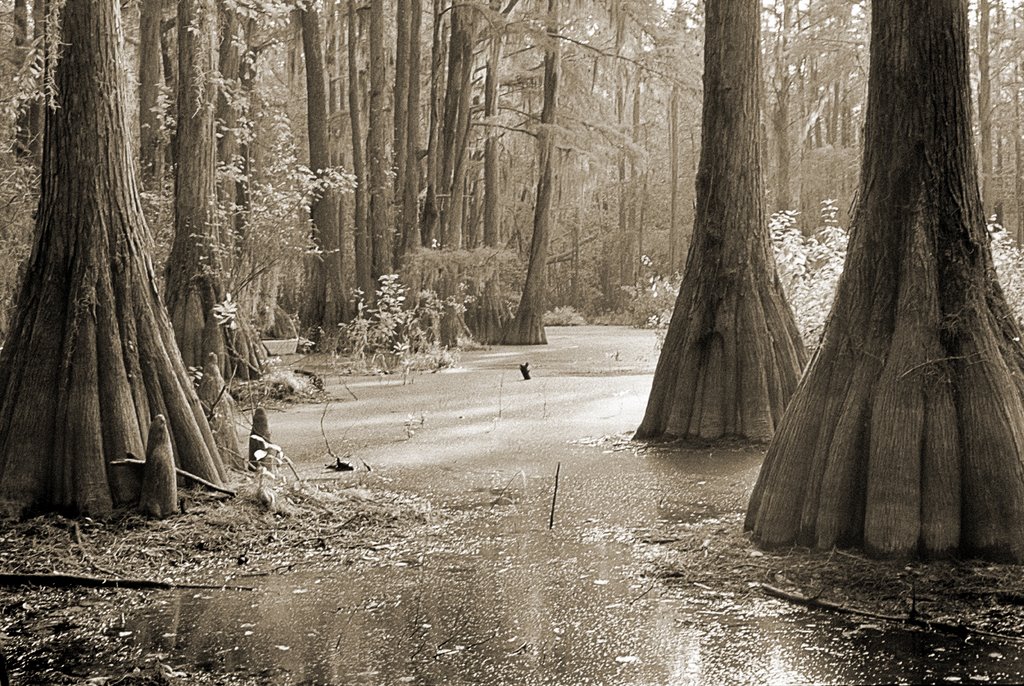
Rather than take a canoe, we took a flatbottom boat with a small outboard and a trolling motor so that we would have enough room for my camera gear and a place to set up a tripod. We were the only ones on the water, silently motoring through the channels that carved into the prairie, watching the sun rise over the cypress in the east. Even though the water was still, my exposures were long enough that we had to stabilize the boat by edging it up onto a peat bog.

I got some fair shots of the prairie with the sun peeking through the trees, but I had to fight a little bit with a cool breeze that was coming up and with the sun playing peek-a-boo through the clouds.

We circled the center of the prairie then worked our way further into the swamp via the canals searching for overhangs of cypress and spanish moss. The backlit moss and the pollen on the surface of the water allowed for some good shots in one of the channels looking straight into the sun. I actually had to settle my tripod into the water, sinking the legs several inches into the mud, just to get a steady shot. (I wish Steve had taken a picture of me leaning over the bow of the boat lining up my shot with my Hasselblad just inches above the tea-colored water.) When the wind died down, and the sun rose high enough, I was able to use my monopod on the bow of the boat to get a steady enough shot.

Day 4 -- October 24, 2006

In the morning, after sleeping in a little bit, I hiked a couple of trails at the East entrance to the Park. Lots of gators, but not much else. Because the water level of the Okefenokee was so low, the whole area at the East entrance seemed more like a lowland forest than a swamp.

During the afternoon, I set out to Chesser Island on foot via the Ridley Island Trail. It's about 2 1/2 miles from the trailhead to the Chesser Homestead. Again, with adequate rainfall, the trail would have borne some resemblance to swampland. As it was, it seemed more like a hike through the woods.

When I got to the Homestead, it as very quiet, very empty, and had a deserted feel to it. It was as if the family tidied everything up, put all their stuff away, and just left. Kind of spooky. One of the things that really enhance the deserted feel was the grounds themselves. The whole of the Homestead property was freshly swept hard-packed white sand with a few scattered Cypress (which is what constitutes much of Chesser Island). I was told that the idea behind keeping the grounds so clean is to keep the Pygmy Rattlesnakes off the property. The snakes don't like the white sand because it gets hot in the sun, and it's very bright. The contrast of the white sand also makes the dark-colored snakes easily visible.

The effect of the Homestead was surreal. These shots were done in infrared to enhance that feeling.

After I returned from Chesser Island, Steve and I went out on the St. Mary's river to try to get some more shots. We put in around 4pm, tooling around until sundown. The river itself is beautiful and peaceful, but not very swamp-like. However, we took the boat into the sloughs -- the small, backwater offshoots of the river -- where there are some very picturesque areas of near complete solitude. Sometimes the sloughs go for a mile or more, and sometimes they barely draw out 50 yards. Most meander slowly through dense overhangs of Cypress, Pine, and Oak, often ending in a cul-de-sac pool of almost-still water covered over with blankets of lily pads. These sloughs provide homes to countless fish, waterfowl, and, of course, alligators. But, not to worry. The gators on the river are much more shy than the gators in the swamp, so the chances of actually seeing one are pretty slim. As a matter of fact, we didn't see a single alligator on the river (compared to one every 50 feet or so in the swamp.)

Deep into the sloughs, the tranquility is almost tangible. During the cooler months of September and October, it would be an ideal camping spot. Nobody around, easy fishing, fresh water... an outdoorsman's paradise.

And, one of the most contrasting, but interesting parts of the river were the beaches. Yes, there are beaches on the river. The inside of some of the curves of both the river proper and the sloughs have clean white sandy beaches. (Just another reminder of how close to the ocean you actually are.)

That evening, as I sat at my cabin cooking some chili for dinner, I met a nice young couple from Germany, Julia and Ulf, as they were moving into the cabin next to me. We sat at the table, had some beer and wine, talked politics, social patterns, cultural norms, etc., and had a great time. They were very intelligent, and the conversation was stimulating. It was a good change of pace from the self-imposed solitude I'd been experiencing for the past few days.


Day 5 -- October 25, 2006

I got up around 6am, packed my gear, and hurried down to the Owl's Nest Tower to try and catch the swamp's prairies nestled in the fog. Had I waited to pack until after I took the photos, I would have gotten some great shots to add to my Fog series. As it was, I was too late, and the sun had already burned the fog off the water. Next time: shoot first, pack later.

After the Tower, I drove straight to St. Mary's, a little town on the Georgia Coast, and hopped on the ferry to Cumberland Island. You can pick up on the Cumberland Island part of my trip in the following entry.

Sunday, October 08, 2006

Trip into the Okefenokee Swamp


Day 1 -- Sunday, October 22, 2006

Well, here I am. Three days in the Okefenokee Swamp!

I arrived late last night. So far, so good.

I'm staying at an outfitter called Okefenokee Pastimes (www.okefenokee.com). They are directly across the street from the entrance to the National Wildlife Reserve (7 miles from the town of Folkston, GA).

I'm in one of their "basic" cabins, but let me tell you, this cabin is a lot nicer than the word "basic" will lead you to believe. For that matter, their whole operation is nicer than I expected. For starters, the cabins are spotless. They are only 8 years old, are completely sealed from the elements (including critters) and are kept cleaner than most hotels I've stayed in. They have air/heat, fans, swing out windows with screens, radios, electricity (including outlets for your personal electronics -- ie: cel phones), coffee makers, screened-in front porches, and picnic tables.

The showers/bathrooms are in a separate building, but that area is just as clean as the cabins. And they have hot water!

Steve and Jo, the proprietors and guides, are two of the friendliest folks you'll meet. Steve took me on my first tour of the swamp this morning (we put in the boat just before sunrise). He is as knowledgeable as he is capable and knows every stump in this area of the swamp.

Since the Okefenokee Swamp is as diverse as it is huge, I decided to familiarize myself a little by going out on my own yesterday, following a designated walking trail that led out to an observation tower overlooking the Swamp. From the tower, I watched the sun go down over the cypress stands, reflecting off the water that seeped up between the scattered peat bogs, and filtering through the Spanish Moss hanging from the trees. It was a bit of a rush to get all the shots I wanted because the sun was sinking so fast, but It was a beautiful sight.


** speaking of which... I shoot film for my artwork, so I don't have instant images to share. We'll both have to wait until I get home and process and scan all my film before we can see what wonderful images I was fortunate enough to capture.**


Day 2 - Monday, October 23, 2006


This morning, Steve and I began with the simple approach of following the water "trail" at the entrance to the wildlife preserve into the "prairies" -- wide open wetlands with lots of small scrub, peat bogs, and a few scattered stands of cypress and pine. If you're a birder, this would be a wonderland for you. We saw so many different kinds of egret, heron, hawk, etc. that I couldn't keep track of them all.

Once we passed through the prairies, we circled around to a more wooded area where the canals were overhung with cypress canopy and spanish moss. There was a light film of pollen on the water that, when the sun shone through the trees, helped create the illusion of a waterway thick with algae.

Once the sun got high enough to warm the banks of the canals, the gators began to come out. Although we got glimpses of them occasionally along the way, we didn't see much more than a snout and eyes. But when the sun came out, they were everywhere. They are gorgeous creatures... and almost everywhere the sun shone on the banks, a big gator was there to sun his hide. They looked so lazy and comfortable, just like a cat stretched out on a window sill (but just a tad more deadly.)


Coming Next...

Tomorrow we go out to a different location on the St. Mary's River (an integral part of the swamp) to look for some different swamp scenery as the sun goes down.

Wednesday I leave the Okefenokee and head out to Cumberland Island where I will camp in a tent with hardly a soul around for 3 days. I won't have access to any computers, so my next posting will likely be when I get down to Ameila Island/Fernandina Beach on the 27th.

Thanks for following along. I'll have pictures up as soon as I can.

Also, please check out my friends, Steve and Jo, at Okefenokee Pastimes (www.okefenokee.com) and my friend, Sandra, at Barwick Studio in Fernandina Beach (www.barwickstudio.com).


www.holtwebb.com
www.myspace.com/holtwebb
© Holt Webb Photography

Sunday, October 01, 2006

Vanishing America


The countdown begins!

The first preparatory leg of the Vanishing America Tour begins on October 15th when I catch a plane to Atlanta to spend a few days with my family and friends. (Of course, I'll have to take one night to go out with my buddy Scott to Wild Bill's Saloon for a little dancin' and cowgirl chasin').

After a few days at home, I'll hop in the car and head down to Folkston, Georgia to shoot in the Okefenokee Swamp. I'll take the backroads along the way (there's just so much more Disappearing America to see) and then spend three days camping in the swamp at a place called Okefenokee Pasttimes. Their guide, Steve, will take me out into the National Wildlife Refuge to get busy with the gators, snakes, birds, cypress, and the St. Mary's river that makes it all happen.

After the swamp, I'll drive up to Georgia's Cumberland Island to spend three days at Sea Camp to photograph the island's wild horses and the ruins of Dungeness.

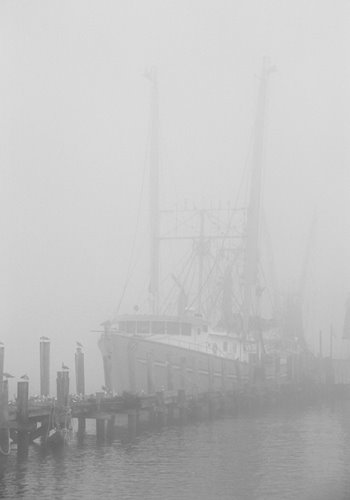
When I leave Cumberland, I'll head down to Amelia Island to continue my series on shrimpboats and the southeastern seashore. While I'm there, I'll drop by Barwick Studio to say hello to my friend Sandra, who has one of my images in her gallery.

If I have time, I'll stay an extra day to catch up with my friends Marcus and Pearl at the Georgia/Florida football game in Jacksonville on Saturday.

Then it's back to Atlanta for a day and then on a plane back to San Diego.

I'll keep updates coming!

www.holtwebb.com
www.myspace.com/holtwebb
© Holt Webb Photography